MAJOR SPOILERS AHEAD. This piece discusses the film’s third act, its central twist and its ending in full detail. Chiikawa the Movie: The Secret of the Mermaid Island premiered in Japan on 24 July 2026 and opened in Singapore and Malaysia on 20 August, so by the time you read this, well over half a month has passed since it hit screens in the region and more than a month since Japan. But this is a Chiikawa movie that lives and dies on what it does in its final act. If you have not seen it yet, bookmark this and come back. Seriously.
The premise: Chiikawa, Hachiware and Usagi are invited to a “special island” for what looks like a lucrative monster subjugation job with an absurdly generous reward. It starts as a summer getaway. It does not end as one.
First, for the uninitiated: Chiikawa is not what it looks like
I’ll be upfront. I never fully followed the manga or the anime. But I’ve always known that Chiikawa isn’t the cutesy little property most people assume it is on first impression, and that gap between packaging and content is exactly what’s made me curious about it for years.
Chiikawa, short for Nanka Chiisakute Kawaii Yatsu or “something small and cute”, is the work of Nagano, an artist who works under a mononym and keeps their identity largely out of view. Nagano first drew the character in May 2017, describing the impulse as wanting to escape modern life and become a simple creature that just cries over its troubles. The series proper launched on X (then Twitter) in January 2020, posted as free, bite-sized strips. Kodansha collected it into print from February 2021, the anime followed in April 2022 via studio Doga Kobo as short segments inside Fuji TV’s Mezamashi TV, and the manga has since cleared 3.6 million copies in circulation and won the 53rd Japan Cartoonists Association Award.
Here’s the part the plushies don’t tell you. Chiikawa (timid, near-nonverbal, cries a lot), Hachiware (chatty, relentlessly optimistic) and Usagi (loud, hungry, “Ura!”) survive by doing licensed labour, namely weed-pulling and discretionary monster extermination, work that can maim or kill. Characters who lose don’t die cleanly. They get turned into monsters, permanently. It is a world with a functioning economy, certification exams, and no safety net. Cute wrapper, cruel engine.
This is the franchise’s first feature film
Chiikawa the Movie: The Secret of the Mermaid Island (映画ちいかわ 人魚の島のひみつ) is the first time Chiikawa has gone theatrical, and at 99 minutes it is by far the longest continuous story the franchise has ever told. That’s no small thing for a series built out of short segments, and it shapes how the Chiikawa movie paces itself.
- Director: Kei Oikawa (Uma Musume Pretty Derby)
- Story and screenplay: Nagano, an original feature script by the creator, adapting the “Siren arc” they serialised on X between March and November 2023
- Animation: CygamesPictures (a switch from the TV series’ Doga Kobo), with QTORY
- Distribution: Toho
- Voice cast: Haruka Aoki (Chiikawa), Makoto Tanaka (Hachiware), Ari Ozawa (Usagi), Minori Suzuki (Siren)
I did not expect Singapore to go this hard
I’ve visited Taiwan a few times in recent years, so I know exactly how crazy Taiwanese are over Chiikawa: the merch, the pop-ups, the queues. What I genuinely did not know was how crazy Singaporeans and Malaysians would be, because there has been very little Chiikawa talk on mainstream platforms here all this while.
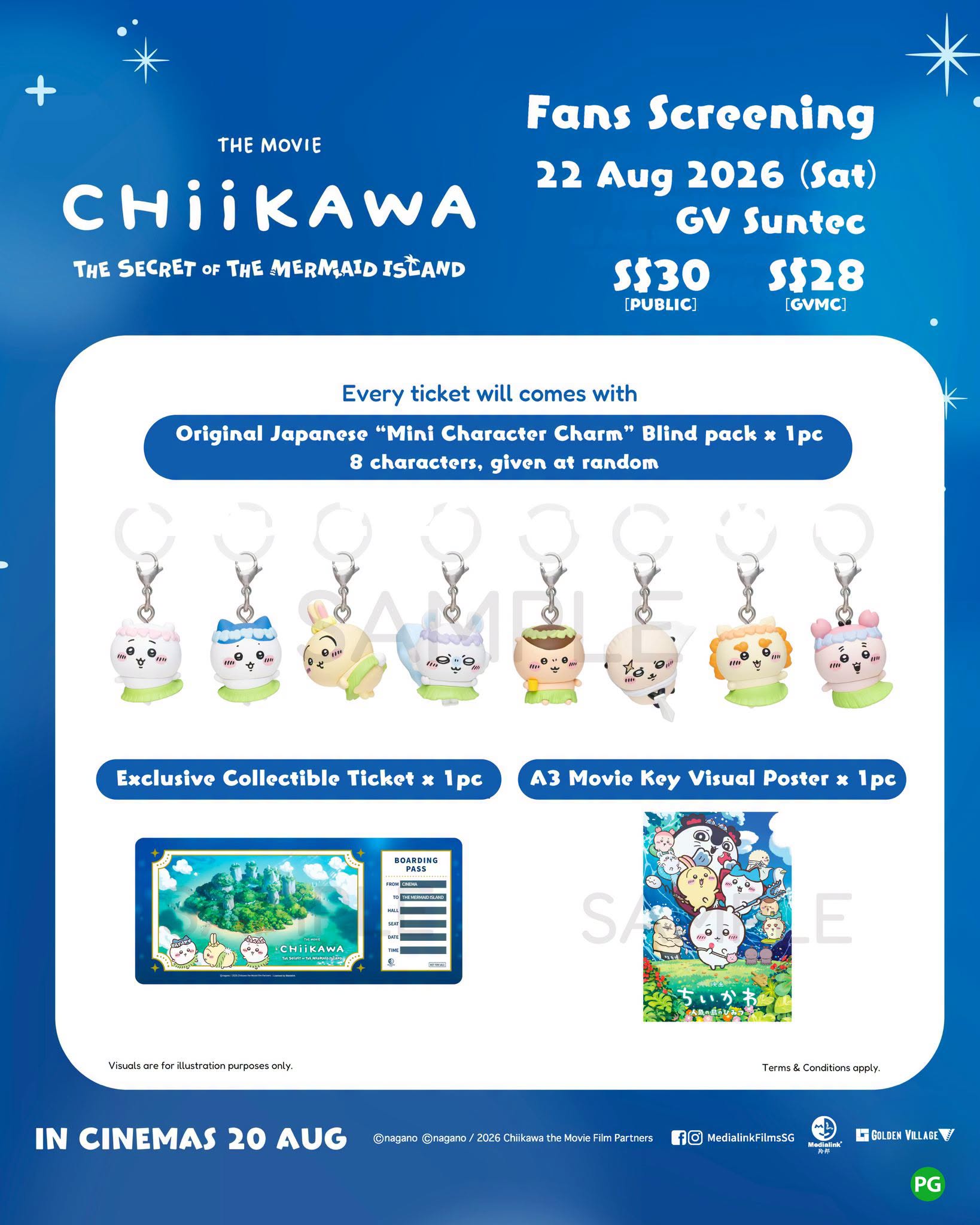
So when Golden Village announced fan screening sessions, I decided this was the one I’d go for.
The first wave sold out within 15 minutes. I picked a 12pm session and tried to pay three times. Three. Each attempt failed, and when I refreshed my browser I found out why. Gone. I scrambled over to the 12.45pm show, which was itself visibly on the verge of selling out, and fortunately got in.
The bundle explains some of it. Tickets were priced at a premium because each one came with original Japanese-version merchandise: a mini character charm blind pack, an exclusive A3 Japanese key visual poster, and a collectible ticket. That’s the same audience-gift logic Toho has been using to power the film in Japan, exported wholesale to Southeast Asia. Malaysia ran the identical play on the same day, with GSC and TGV both selling RM60 fan screening packages on 22 August.
On screening day itself, the atmosphere at Golden Village Suntec City was genuinely lively, with merch out and people comparing charms. I never knew there were this many Chiikawa fans in Singapore.
Ninety-nine minutes later, most of us walked out of the Chiikawa movie considerably quieter.
The numbers, for context
Japan has treated this as an event film. It opened to ¥990 million on day one and ¥2.24 billion across its first three days (1.5 million admissions), and by day 24 had cleared ¥9.28 billion from 6.45 million admissions, running at a pace that puts it among the ten fastest anime films ever to the ¥10 billion mark, in company with Demon Slayer: Mugen Train and One Piece Film Red. Global takings are somewhere around US$159 million.
Taiwan opened on 31 July (Mandarin dub from 7 August), did over NT$40 million in its first week, and crossed NT$100 million by 16 August.
But the more interesting number is the volume of Taiwanese content that has since sprung up around how dark this film is: YouTube explainers unpacking the ending, the Greek myth behind Siren, hidden meanings in the theme song, pre-viewing primers for people with zero Chiikawa background. Taiwanese outlets have reported cinemas going dead silent at the credits, children filing out with the smiles wiped off their faces, and a live argument that the local PG rating should have been stricter. The clip that best sums it all up is of an 84-year-old Japanese grandmother, Yoshiko, a devoted Chiikawa fan filmed leaving home beaming with her plush in her arms, and coming home unable to raise a smile.
I have seen dark. Movies, anime, tokusatsu. I’ve watched a lot of grim things. What this Chiikawa movie pulls off is next level.
How it gets you
It starts exactly like any episode of Chiikawa. Bright, cute, good vibes.
Usagi gets a marketing flyer for a subjugation event delivered directly to his face. Literally: thrown at him by a bird whose entire personality is doing the V pose, peace sign and all, except with its wings. Usagi brings it to Chiikawa and Hachiware, and Hachiware lights up at the 100x reward printed on it. Sensibly, Hachiware suggests running it past their teacher, Rakko. Rakko finds the whole thing suspicious, correctly, right up until he spots that free sweets will be provided. In they go.
On arrival, the group is warmly welcomed. Chiikawa promptly develops seasickness, and Hachiware asks for tansan (タンサン), carbonated water. Hitoha and Futaba are visibly, strangely alarmed by the request, and only relax once Hachiware explains what he actually means. It plays as a throwaway gag. It is not a throwaway gag.
From there the film runs its usual service for a good while. Kurimanju-senpai is being exactly himself. Shisa is jovial. I’m still not entirely sure what either of them was doing in this story. Not a complaint, just a fond jab, because Shimajiro contributed more to the plot than the two of them combined.
Long story short: the gang drives off Siren and the mermaids. Victory. You feel the film settling toward a warm ending.
Wrong.
The turn
We are then shown that Hitoha brought Futaba back by replacing its battery, and crucially, we see it through Chiikawa’s eyes. That battery is the “sign” Siren described earlier in the film, the tell that marks someone who has eaten mermaid flesh.
Hitoha and Futaba see that Chiikawa has just witnessed the truth. Chiikawa says nothing.
Then the film gives us the rest of it. Hitoha and Futaba were accidentally struck by Siren and the mermaids on a fishing trip. Futaba was critically injured. Hitoha remembered a passage in a book: eat the flesh of a mermaid and gain eternal life. Overwhelmed by rage and desperation, Hitoha went hunting.
What followed dropped the entire cinema into silence. Hitoha lures one of the mermaids in with bait, and then Nagano does not show it. The killing happens off-screen, conveyed entirely through the sound of Hitoha bashing the mermaid to death. It is one of the most effective pieces of restraint I have seen in an animated film, and it is in a Chiikawa movie.
Hitoha feeds a piece of the flesh to Futaba, who comes back. And when Futaba learns what happened, Futaba force-feeds a piece to Hitoha, terrified of being the one left behind after everyone else is gone.
Remember what Siren promised earlier in the film: once the culprit is found, they will be imprisoned in a cage beneath the sea, for eternity.
Nagano’s real source material
This isn’t invented mythology. Nagano is drawing on 八百比丘尼 (Yao Bikuni), the “eight-hundred-year nun”, one of Japan’s oldest and saddest legends, in which a young woman unknowingly eats the flesh of a ningyo and stops ageing, outliving her husbands, her children and everyone she has ever known across eight centuries until all she wants is to die. It’s the same well Tezuka Osamu drew from for Phoenix and Rumiko Takahashi for Mermaid Saga, and Japanese viewers clocked it immediately. The legend trended alongside the film’s release.
Which reframes Futaba’s decision completely. Force-feeding Hitoha isn’t cruelty. It’s Futaba recognising the Yao Bikuni ending coming and refusing to face it alone. Nagano fuses that Japanese folk horror onto a Greek Siren, and the result is a story where the punishment isn’t death. It’s duration.
The part I’m still turning over
Chiikawa doesn’t know the full story. He knows a fragment. And he is now cursed with exactly that, partial knowledge, and right to the end, he tells no one.
That is an enormous burden, and the film refuses to lift it. If Chiikawa had exposed Hitoha and Futaba, the two of them would be in serious trouble. But it is precisely because of what those two did that so many of their fellow villagers were killed, innocently, in the retaliation that followed. Speak and you condemn them. Stay silent and you carry it.
I’m told this set off enormous discussion in the Japanese fan community, and I believe it, because Nagano deliberately declines to do the standard thing here. There’s no verdict handed down. No villain named. It’s left to the audience to sit with it and decide.
Murder is never the answer. That’s the easy part. But in that specific moment, with your partner dying in front of you and a way out written in a book you happen to have read, what would anyone do? And did Siren genuinely not see Hitoha and Futaba out there? Siren reads as a reasonable character throughout. If Siren had simply turned back to check what it had hit, does any of this happen?
All the ifs. Every one of them a place where the tragedy could have stopped, and didn’t.
How do you cope with a situation where, in the end, nobody is really at fault?
That’s the question a movie about a small crying creature and its two friends left me standing in the Suntec lobby with. I don’t have an answer. I’m not sure Nagano wants me to.
More Japanese cinema on tokuAsia: Godzilla Minus Zero: Everything We Know So Far and Kamen Rider Kabuto 20th Film: Cast, Date and V-Cinext.
Official sources
- Chiikawa the Movie: The Secret of the Mermaid Island official site (Toho)
- @chiikawa_movie on X
- @chiikawa_movie on Instagram
- Singapore fan screening and release listing: Golden Village
- Malaysia RM60 fan screening packages: GSC Cinemas on X
Follow @tokuasia.sg on Instagram for more Chiikawa and Japanese cinema coverage as it happens.
This article is written with assistance from Claude.